

If There’s a War, Why Are Markets Near All-Time Highs?
May 1, 2026
Turn on the news right now and it’s hard to avoid the headlines. Rising geopolitical tensions, conflict overseas, and ongoing uncertainty around oil, inflation, and global stability are dominating the conversation. Given all of that, it would be reasonable to assume that markets must be struggling.
And yet, they’re not.
In fact, markets have been hovering near all-time highs. That disconnect can feel confusing, especially when the broader environment feels anything but stable. If uncertainty is increasing, why aren’t markets reacting the way most people expect?
The answer comes down to how markets actually process information.
Markets Don’t React—They Anticipate
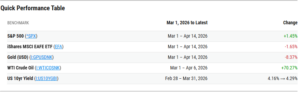
Markets are forward-looking, not backward-looking. When a major geopolitical event occurs, there is usually an immediate reaction. Prices move quickly, often within hours or days, as new information gets absorbed. We saw that recently with oil prices spiking, equities pulling back, and volatility picking up.
Here’s a snapshot of how different parts of the market have actually performed since the conflict began:
Source: YCHARTS
But that initial move is only the first step.
After the reaction, markets begin to evaluate what’s likely to happen next. Investors aren’t just focused on what is happening today—they’re asking how long the situation might last, how severe it could become, and what the broader economic implications might be. As those expectations take shape, prices adjust accordingly.
That’s why markets can stabilize or even recover while the headlines remain uncertain. They’ve already begun pricing in what they believe is most likely to happen moving forward.
Markets Think in Probabilities, Not Headlines
When we see conflict, it’s natural to simplify it. The instinct is to think in binary terms—war is bad, so markets should go down. But markets don’t operate that way.
Instead, they evaluate a range of possible outcomes. A conflict could be short-lived with minimal disruption, or it could become more prolonged but remain contained. There is also the possibility of a broader escalation that affects global trade, energy supply, or economic growth. Markets assess each of these scenarios and assign probabilities to them.
As those probabilities change, markets adjust.
This is why you often see sharp initial reactions followed by stabilization. Even though the situation itself may still feel uncertain, markets are continuously recalibrating based on what they believe is most likely—not simply reacting to the headlines in front of us.
What Feels Like a Crisis Often Isn’t
During periods of heightened uncertainty, there is often a gap between perception and reality. When headlines are constant and the tone is negative, it can feel like markets must be under significant stress. But if you step back and look at the numbers, the picture is often more measured.
Even during the recent volatility, markets were only down about 5–6% from their highs before rebounding. That type of movement is well within the range of normal market behavior. It may feel significant in the moment, but it is not unusual when viewed in a broader context.
That distinction matters, because how something feels in real time can lead to decisions that don’t align with long-term outcomes.
We’ve Seen This Before
Geopolitical conflict is not new, and markets have navigated similar environments many times. While each situation is different, the overall pattern tends to be consistent. There is an initial reaction as uncertainty rises, followed by a period of adjustment, and ultimately a return to focusing on underlying fundamentals.
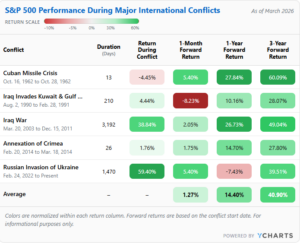
If we zoom out, the historical pattern becomes even clearer:
Source: YCHARTS
Historical data across multiple conflicts shows that markets have often produced positive returns in the 12 months following the start of major geopolitical events. Over longer time periods, those returns become even more meaningful.
This doesn’t mean volatility disappears, and it doesn’t minimize the seriousness of global events. It simply reinforces that markets have historically shown resilience, even during periods that feel uncertain.
The Real Drivers Haven’t Changed
While geopolitical events dominate the news cycle, they are not the primary drivers of long-term market performance. Markets are ultimately driven by corporate earnings, interest rates, Federal Reserve policy, inflation, and overall economic growth.
At the moment, corporate earnings have remained strong. Interest rates have been more persistent than expected, and energy prices are something to watch—particularly if they remain elevated and begin to influence inflation more meaningfully. But so far, those factors have not materially altered the broader market outlook. For markets to experience a sustained decline, you typically need to see deterioration in those underlying drivers. Headlines alone are usually not enough.
What Should You Do?
This is where things become more practical. When uncertainty increases, the instinct is to take action—move to cash, wait for clarity, or try to find a better entry point. The challenge is that those decisions often come at the wrong time.
Markets tend to rebound quickly, and those rebounds frequently happen before it feels comfortable to re-enter. By the time things appear more stable, a significant portion of the recovery has already occurred. Even in this recent environment, many portfolios have held up far better than people expected—something that isn’t always obvious if you’re only following headlines.
Missing even a short window of strong market performance can have a meaningful impact on long-term returns. Maintaining discipline and adhering to a long-term plan is often a common approach during periods of market uncertainty. While it may not always feel comfortable, this approach has historically been associated with more consistent long-term outcomes.
Staying Grounded in Your Plan
If your portfolio has been built thoughtfully—with appropriate diversification, liquidity, and alignment to your long-term goals—it is designed to navigate periods like this. That doesn’t mean volatility won’t occur, but it does mean you don’t need to react to it.
Making changes based on short-term events can introduce unnecessary risk and disrupt a strategy that is intended to work over time. Staying consistent allows the plan to do what it was built to do, even when the environment feels uncertain.
Final Thoughts
Times like this can feel unsettling. The headlines are constant, and the uncertainty is real. It’s natural to question whether markets should be reacting differently. But markets are not driven by headlines alone. They are shaped by expectations, probabilities, and long-term fundamentals.
And more often than not, they have shown the ability to move forward—even in the middle of uncertainty.
If you have questions about how your portfolio is positioned or want to revisit your overall strategy, it’s always worth having that conversation. In many cases, though, the most important step isn’t making a change—it’s making sure your plan is built to withstand moments like this.
This material is provided for informational purposes only and is not intended as investment advice or a recommendation to buy or sell any security. The market data shown represents historical performance during select geopolitical events and is not indicative of future results. There can be no assurance that similar market outcomes will occur following current or future events.
The conflicts and time periods presented are illustrative and do not represent a comprehensive analysis of all geopolitical events or market conditions. Results may vary significantly depending on timing, market environment, asset allocation, and other factors.
Forward returns are based on historical index data and assume reinvestment of dividends. Index performance does not reflect the deduction of fees, expenses, or taxes, which would reduce returns. Investors cannot invest directly in an index.
Past performance is not indicative of future results. All investing involves risk, including the possible loss of principal.