

The AI Bubble: pressing problem or inflated pessimism?
October 27, 2026
It’s a topic that’s making headlines and one that many of our clients are referring to as if it’s already a sure thing—the AI bubble.
AI enthusiasm is running high, and the companies behind it seem to be on the fast track for world domination. Or at least, stock market domination. So it makes sense that people are concerned. The hype around AI has some striking parallels to the internet boom of 1999, and we all know where that landed us.
But while AI is undoubtedly making unprecedented waves in the economy, that doesn’t mean history is doomed to repeat itself. In fact, there are several key differences today that indicate we’re not in another bubble.
Why this isn’t 1999 all over again
Many analysts are reporting that we’re entering a “speculative bubble stage” with AI, but as Howard Marks, the cofounder of Oaktree Capital Management, noted recently, there are several important differences in pre-bubble investor behavior and what we’re seeing today.
He pointed out that what typically creates an investment bubble is “irrational exuberance.”[1] Everyone is making money, FOMO takes over, and investors start ignoring risks. Valuations become irrelevant. Marks made the point that in the late 90s, companies had only to put “dot com” behind their name to see a rise in stock price. But we’re not seeing that kind of irrationality today. There’s enthusiasm around AI, sure—you won’t see a “Brunch with Bryan” that doesn’t include an article about its latest development—but investors aren’t demanding to buy into certain companies at any cost because they’re taking over the world.
In fact, we’re seeing a bit of the opposite. Investors are showing caution because of the hype around AI. And ironically, that fear of a bubble is partly what’s preventing it. Investors are monitoring AI spending, interest rates, inflation, and geopolitics, understanding that the wrong combination could make markets turn the other way. They’re not buying hand over fist; they’re making cautious, selective decisions because they recognize the real possibility of a bubble.
And that kind of behavior doesn’t typically lead to bubbles.
On Prices and Earnings
In 1999, there was a running joke that it was difficult to determine a P/E (price to earnings) ratio when there was no “E.” Prices skyrocketed; earnings did not.
That’s not what’s happening today. The big names in AI are making record earnings and growing at phenomenal rates—and the prices are reflecting that, but not in an overinflated way. Earnings are growing at faster rates than stock prices, which may make these companies appear less expensive based on certain valuation metrics, such as price-to-earnings ratios. Compare that to the dot-com bubble, where the five largest tech companies in the early 2000s traded for 65 times their annual earnings, and the 23-times-earnings prices we’re seeing today for the top five[2] don’t seem so steep. These companies have substantial profits, established businesses, and strong cash flows, so that kind of valuation is fairly reasonable.
This leads us to another reason to believe we’re not entering a bubble. Lower price-to-earnings ratios could be because investors are expecting the stock to slow down.
In many cases, investors pay for future growth expectations. If a company is growing at a phenomenal rate, an investor might recognize that the P/E is inflated, but they excuse it with the expectation that the company will grow into its valuation. What we’re seeing now is the flip side of that rationale. Investors recognize that earnings are strong, but instead of raising the price, they’re taking a conservative approach on the chance that earnings slow down or even decelerate.
So again, investor caution is itself helping prevent a bubble.
The real concerns
That doesn’t mean there are no fiscal risks with AI, though.
For one, we have a small handful of tech companies driving market share, which creates concentration risk. Today, Nvidia, Apple, and Microsoft make up about 21 percent of the S&P 500, whereas in 1999, ten companies held that same percentage of the market. Why is that an issue? If you own an S&P fund and you think you have a well-diversified portfolio, you actually have twenty percent of one fund invested in just three stocks. That doesn’t mean it’s not an appropriate investment for some people, but it could create a false sense of diversification.
Another concern is AI spending. These companies are spending exorbitant amounts of money—building data centers, buying AI infrastructure, purchasing semiconductors—and just a year or so ago, that money was coming from healthy cash flow. But the same can’t be said of their spending habits today, as more companies are using debt to fund their growth.
This wouldn’t be such a concern if the same companies weren’t also relying on circular financing, something we noted in a blog last year. In simple terms, this is when Company A produces something (say, semiconductors), and they invest in Company B, which then purchases services from Company C, which then turns around and buys the semiconductors from Company A.
It’s not a completely unusual practice, but when a company is essentially financing demand for its own product, that creates a skewed perception of the demand, and things can turn south quickly for all the companies involved if one doesn’t get its expected return on investment.
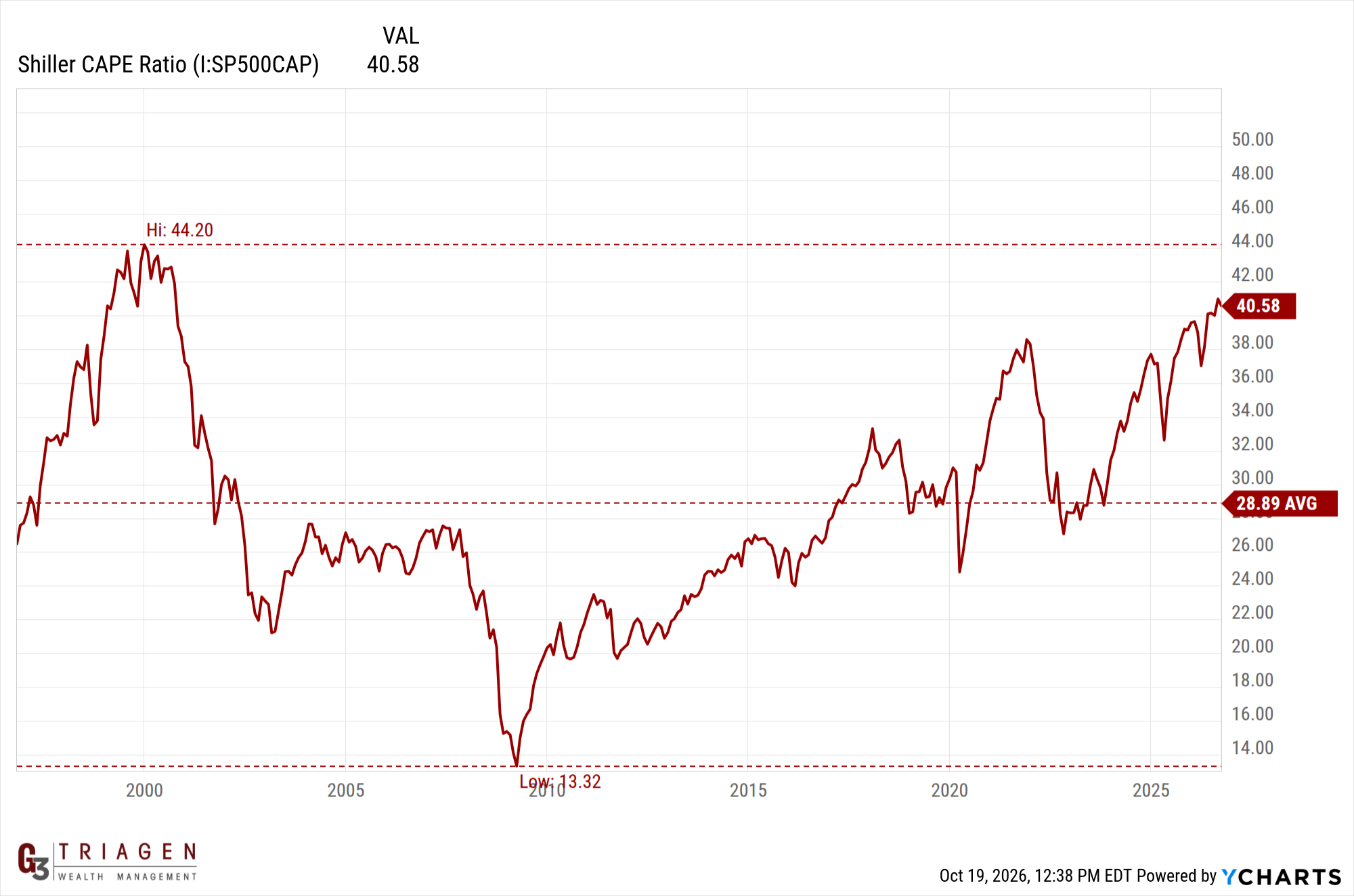
The other concern is the Shiller CAPE ratio, which considers stock prices over corporate earnings for the previous 10 years with an inflation adjustment. The Shiller CAPE ratio is approximately 41 as of October 2026, reflecting elevated equity valuations relative to historical levels, although it remains below the levels reached during the late 1990s.
The concern is that historically, elevated valuations mean longer-term returns are lower because the pricing has been pulled forward. That said, valuations are notoriously poor at predicting short-term returns. In fact, Shiller Cape ratios have been a topic of discussion for some time, and the markets have continued to run strong.
But it’s changing the world!
For those trying to rationalize investment behavior with the argument that AI is truly changing the world, we feel it’s important to note that, yes—many of the claims about AI and its impact on society likely aren’t far-fetched. It will change the world. It already has.
But so did the internet.
The 1999 bubble didn’t burst because the internet failed to live up to its expectations. The companies investors relied on did. Not every front-runner of the time became an enduring leader in the space (looking at you, AOL), and some of the most impressive performers, like Cisco, took 25 years to bounce back after significant drops.
The lesson? Life-altering technology does not equal an infallible investment. And because no one has a crystal ball, it’s wise not to place all your bets on what you hope might be the next Google, when it could very well be the next AOL.
What you can do
So, while current market conditions may differ from previous bubbles, there are still some concerns worth considering. And right now, the best thing you can do is be informed and follow a long-term plan (novel, right?). Understand what’s happening in the markets, and make sure you have the money you need soon in an appropriate short-term bucket, and the money you’ll need later set aside in a longer-term bucket.
Because either way, the market is going to fluctuate. Whether the bull theorists win out and the markets keep climbing, or the bears are proved right and we experience a correction because of high valuations, you need a plan that accounts for volatility—considering your short-term financial needs while positioning your investments for potential long-term growth.
That’s something that’s never going to change.
[1]https://www.bloomberg.com/news/articles/2026-10-18/billionaires-warn-of-a-bubble-yet-howard-marks-is-unconvinced?cmpid=101926_marketsdaily
[2]https://www.bloomberg.com/news/articles/2026-10-18/billionaires-warn-of-a-bubble-yet-howard-marks-is-unconvinced?cmpid=101926_marketsdaily